



 Full Games List
 Featured Games
 New Games
 Reviews
 Media
Media Blogs
Blogs Game Updates
 Images Feedback Summary
 Game Design Highlights
 Articles
 Scripts
 Utilities / Plugins
 Resources
 Engines
 Engine Bulletins
 What is Makerscore?
 Past Events
 Achievements
 Misaos
 Forums
 Chat
Chat New to RMN?
 Full Store List
 RMN Music Pack (free)



 Profile
 Locker
 Play Lists
KAZESUI'S PROFILE

 Close
Close



Search
Filter
 All
All Game Pages
 User Statuses
 Brainbow
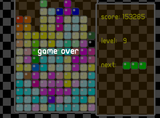
Normally, it wouldn't be that hard, true enough. But this project is pretty much the result of some dire cowboy coding, meaning it wouldn't be that simple after all, unless I'd want add variables to keep track of the current shape and then make a lookup for the current shape.
The cowboy coding resulted in the actual order of the blocks in the shape being relevant to some later calculations (...I think), which is what's making the trouble. Otherwise I could probably just have created a tiny matrix where I could more generically done a rotation for any shape.
It's not just that it would be a hassle to implement either though, but rather that I'd rather give priority to other stuff, like names for high score and possibly a puzzle mode as well (which probably would be more hassle, but more interesting to implement as well).
But who knows, I might look into it anyway and see if I'll see some genius way to fix it regardless
The cowboy coding resulted in the actual order of the blocks in the shape being relevant to some later calculations (...I think), which is what's making the trouble. Otherwise I could probably just have created a tiny matrix where I could more generically done a rotation for any shape.
It's not just that it would be a hassle to implement either though, but rather that I'd rather give priority to other stuff, like names for high score and possibly a puzzle mode as well (which probably would be more hassle, but more interesting to implement as well).
But who knows, I might look into it anyway and see if I'll see some genius way to fix it regardless
Brainbow
Rotation wouldn't add that much to the game since the pieces fall into places anyway, and it would be a hassle to implement properly. I do plan to look into a name slot for the high scores though.
 BlendingB.PNG
Not exactly random. If you mess around with RGB values of any image editing software, you're likely to notice that you get the same result as you see up here. This is also explained by the blocks being composed of the 3 components red, green and blue, rather than conforming to "realism".
If more realism were to be applied, you'd never end up with white (which is more or less the objective). I'm aware that it is a bit unintuitive, and made this picture to help it a bit. Playing the game for a little while is also likely to make you remember what colours to combine.
If more realism were to be applied, you'd never end up with white (which is more or less the objective). I'm aware that it is a bit unintuitive, and made this picture to help it a bit. Playing the game for a little while is also likely to make you remember what colours to combine.
 Pointers in Rpg Maker 2k(3)
Yep, that's right. If you're referencing variable 0001, and that variable has the value 5, then you will point at the value of variable 0005 instead.
The best way to avoid confusion it to simply try out some simple stuff to make sure that you've understood it. Like, create an npc which does a few variable operations, and check the debug menu with F9 to check if the result is the same as you expect it to be (which is how I learned to use them).
You don't need pointers to make puzzles, but once you know how to use them, they can make complicated puzzles easier to code.
The best way to avoid confusion it to simply try out some simple stuff to make sure that you've understood it. Like, create an npc which does a few variable operations, and check the debug menu with F9 to check if the result is the same as you expect it to be (which is how I learned to use them).
You don't need pointers to make puzzles, but once you know how to use them, they can make complicated puzzles easier to code.
Tactical Battle System Movement
What, I have to make game too?
initially, I had no plan of making a game with the system, but having worked with it, an idea did pop into my mind. But I also have lot of other stuff to do, so only time will tell if I'll make something out of the idea.
initially, I had no plan of making a game with the system, but having worked with it, an idea did pop into my mind. But I also have lot of other stuff to do, so only time will tell if I'll make something out of the idea.
Tactical Battle System Movement
This is how the TBS will look in the end: youtube link
No idea when I'll write the two remaining tutorials yet, but at least the system is done so it's only a matter of sitting down and writing the tutorials
No idea when I'll write the two remaining tutorials yet, but at least the system is done so it's only a matter of sitting down and writing the tutorials
 Strategy RPG Game Idea
Yep, as Killer Wolf said. Using pointers you can access as many as 9,999,999 variables in rm2k3, which is more than enough for any of the typical path finding algorithms.
That said, it's perfectly possible to have path finding systems for maps of 30x30 (i.e. not too big) not using more then around 1500 variables (Where it'd pretty much be worst case scenarios if you'd had to use all of them for an execution of the path finding algorithm), and 3500 variables should be enough for the rest of the game unless you have some very special systems going on.
That said, it's perfectly possible to have path finding systems for maps of 30x30 (i.e. not too big) not using more then around 1500 variables (Where it'd pretty much be worst case scenarios if you'd had to use all of them for an execution of the path finding algorithm), and 3500 variables should be enough for the rest of the game unless you have some very special systems going on.
Tactical Battle System Movement
The plan so far is to look on "player interfacing" in the next part of the TBS tutorial series. This includes how to make players attack, to make enemies lose hp and stuff like that.
After that, I'm planning on concluding the series with how to implement a "simple" enemy AI, which will be using something similar to the dijkstra algorithm from the other tutorial to determine where to go (which is important if the enemy is far away from the player and there are lot of obstacles on the map).
That's the plan at least.
The combat won't look very fancy though. Think advance wars without the scene showing the units attack each other.
After that, I'm planning on concluding the series with how to implement a "simple" enemy AI, which will be using something similar to the dijkstra algorithm from the other tutorial to determine where to go (which is important if the enemy is far away from the player and there are lot of obstacles on the map).
That's the plan at least.
The combat won't look very fancy though. Think advance wars without the scene showing the units attack each other.
Pointers in Rpg Maker 2k(3)
Going through how to make an item submenu is probably a good way of learning how to use pointers as it makes good use of pointers, yeah.
As for general applications for pointers, it will often end up to abstract or too specific, which makes it hard. Most of the relevant key points is presented in the puzzle implementation. Usually pointers are used within the context of something more complex, often custom systems of different kinds.
Pointer's are good for storing data into an unknown or adjustable amount of variables, and are also good for retrieving the same numbers without using tons of branches.
Let's take an ABS as an example. Let's say that the enemy hp is stored in variable 21 to 40 and that variable 21 refers to the hp of enemy 1, 22 to enemy 2 and so on.
Let's also say that you create the enemy events systematically, so that their ID's are consecutive and making the event ID's from 11 to 30.
Now, when you attack, you can each time check for all 20 different enemies if you've landed an attack with lot's of branches. However, this isn't very effective and it's a bit of work as well. Something one could do instead is to make use of the "get event ID" on the coordinates of the attack. If there's an enemy there, you'll get it's ID. We just have 2 branches now, which checks if the event ID was from 11 to 30. Now we need to make sure the add/subtract hp from the variable of the enemy you just hit. If we take the ID you just got, and add 10 to it, we'll have a number in the range 21 to 40, which would correspond to the variables with the enemy hp! By using this value as a pointer, we can work on the correct variable with hardly any code (as opposed to using 40 branches to check for each possible enemy)
And this is only a very simple implementation, which doesn't consider a lot of things like defense of enemy or so, but to add all that would turn it into an ABS tutorial instead. This is a reason why I don't have very many examples on pointers in this tutorial, since the principles are basically the same. I'm planning to create more tutorials which make use of pointers as well, including my take on ABS systems as well.
The truth is that I only made this tutorial so that I could reference it in the other tutorials I make since they often include pointers. So don't worry, more examples are coming. Hopefully some a bit less complicated than the TBS ones
As for general applications for pointers, it will often end up to abstract or too specific, which makes it hard. Most of the relevant key points is presented in the puzzle implementation. Usually pointers are used within the context of something more complex, often custom systems of different kinds.
Pointer's are good for storing data into an unknown or adjustable amount of variables, and are also good for retrieving the same numbers without using tons of branches.
Let's take an ABS as an example. Let's say that the enemy hp is stored in variable 21 to 40 and that variable 21 refers to the hp of enemy 1, 22 to enemy 2 and so on.
Let's also say that you create the enemy events systematically, so that their ID's are consecutive and making the event ID's from 11 to 30.
Now, when you attack, you can each time check for all 20 different enemies if you've landed an attack with lot's of branches. However, this isn't very effective and it's a bit of work as well. Something one could do instead is to make use of the "get event ID" on the coordinates of the attack. If there's an enemy there, you'll get it's ID. We just have 2 branches now, which checks if the event ID was from 11 to 30. Now we need to make sure the add/subtract hp from the variable of the enemy you just hit. If we take the ID you just got, and add 10 to it, we'll have a number in the range 21 to 40, which would correspond to the variables with the enemy hp! By using this value as a pointer, we can work on the correct variable with hardly any code (as opposed to using 40 branches to check for each possible enemy)
And this is only a very simple implementation, which doesn't consider a lot of things like defense of enemy or so, but to add all that would turn it into an ABS tutorial instead. This is a reason why I don't have very many examples on pointers in this tutorial, since the principles are basically the same. I'm planning to create more tutorials which make use of pointers as well, including my take on ABS systems as well.
The truth is that I only made this tutorial so that I could reference it in the other tutorials I make since they often include pointers. So don't worry, more examples are coming. Hopefully some a bit less complicated than the TBS ones
 Games - Tester
 Games - Other
