



 Full Games List
 Featured Games
 New Games
 Reviews
 Media
Media Images
 Blogs
Blogs Game Updates
 Images Feedback Summary
 Game Design Highlights
 Tutorials
 Articles
 Scripts
 Utilities / Plugins
 Resources
 Engines
 Engine Bulletins
 What is Makerscore?
 Past Events
 Achievements
 Misaos
 Forums
 Post History
 Chat
Chat New to RMN?
 Full Store List
 RMN Music Pack (free)



SILENT HERO OR NON SILENT HERO?
Posts
Pages:
1
 redman45
 View playlists
 Close
CloseI'm recently starting a new RPG project and can't decide if I would have a silent hero where players choose his actions or a hero with a predetermined personality.
I always liked the silent hero in games (Suikoden & Persona series) opposed to the ones where the hero voices his opinions because a lot of the time I'm turned off by a hero's emotional mood swings while I feel a silent hero lets me voice who the player wants to be. I preferred Dragon Age over Dragon Age 2 because I didn't like the hero talking all the time.
So what are you guy's opinion on silent heroes and those with personalities? Which do you relate to more?
I always liked the silent hero in games (Suikoden & Persona series) opposed to the ones where the hero voices his opinions because a lot of the time I'm turned off by a hero's emotional mood swings while I feel a silent hero lets me voice who the player wants to be. I preferred Dragon Age over Dragon Age 2 because I didn't like the hero talking all the time.
So what are you guy's opinion on silent heroes and those with personalities? Which do you relate to more?
Both are completely acceptable ways of telling a story.
It all comes down to which is more effective for YOUR game. I would use a silent hero if you can't come up with an interesting main character, or a main character that moves the main story.
Don't make a Vaan. Well... you can if needed. But it's mostly frowned upon.
It all comes down to which is more effective for YOUR game. I would use a silent hero if you can't come up with an interesting main character, or a main character that moves the main story.
Don't make a Vaan. Well... you can if needed. But it's mostly frowned upon.

Personally, I prefer non-silent heroes, heroes who are characters in their own right. Heroes who are themselves characters make the world look more vibrant, the interactions more real, the story more compelling, and the characters (including the hero) more memorable.
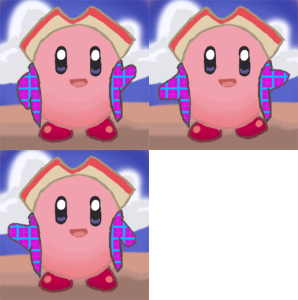
I also prefer non-silent, silent ones for me just end being the same character as always, a silent one with lack of personality since I don't really feel like adding one to them. Also it's kind of funny for me see how everyone understand the silent hero like if they were reading their minds, that reminds me of this.
Of course I don't want Link to have dialogues since I am really used to it.
Of course I don't want Link to have dialogues since I am really used to it.
In my opinion: well written heroes > OK written heroes > silent heroes > poorly written heroes.
The silent heroes are just silent characters for me, if they don't talk, I don't imagine them talking. Worst case scenario, I don't even see them as people. I remember that when Crono died, I felt sorry for his friends, but not for Crono himself.
That said, the problem with heroes turning me off is a common problem and often I find poorly written heroes worse than silent ones. Usually, a ham-fisted attempt at character development is to blame. A decently written hero beats a silent one though. You don't even have to be a good writer to make a decent character, all you have to do is to not attempt something above your writing skills.
The silent heroes are just silent characters for me, if they don't talk, I don't imagine them talking. Worst case scenario, I don't even see them as people. I remember that when Crono died, I felt sorry for his friends, but not for Crono himself.
That said, the problem with heroes turning me off is a common problem and often I find poorly written heroes worse than silent ones. Usually, a ham-fisted attempt at character development is to blame. A decently written hero beats a silent one though. You don't even have to be a good writer to make a decent character, all you have to do is to not attempt something above your writing skills.

The only games with a silent hero that I like are the Pokémon series and Legend of Mana.
In Pokémon the center is on gameplay, not on story. A too strong character that contradicts the players demands would be too distracting.
In Legend of Mana the observing point of view is intended for gameplay. You watch as a world unfolds and help out NPCs here and there, but you seem more to be invisible to them, like a guarding angel or something like that.
In Pokémon the center is on gameplay, not on story. A too strong character that contradicts the players demands would be too distracting.
In Legend of Mana the observing point of view is intended for gameplay. You watch as a world unfolds and help out NPCs here and there, but you seem more to be invisible to them, like a guarding angel or something like that.
I think the issue of silent vs. non-silent protagonist largely depends on your own area of comfort.
A non-silent protagonist is fine if you're good at avoiding cliches and overly long, forced conversations. This one has the bigger risk but also a higher reward as such a protagonist is more likely to be memorable, but not necessarily for a good reason. If the only character you can think of is along the lines of a hot-headed good-hearted youth who falls in love with the first girl he meets and wants to save the world while spouting off about the importance of friendship or if the only way you can think of to develop a character is to have the party sit around at a campfire/inn as the protagonist goes on at length about his/her tragic past, you'll want to avoid this.
Silent protagonists are the 'safer' of the two, but are harder to pull off unless you want them to be a completely blank slate. Writing is still important here, but instead of there being a focus upon direct dialogue, there is now a focus upon pantomime, actions taken, and the reactions of other characters. Players are unlikely to ever understand silent protagonists on the same level as a well-written non-silent one, but this does not mean a silent protagonist cannot be a distinct character. Dragon Quest V is a fantastic example of a game which makes players care about a silent protagonist. However, while MrChearlie may have posted that Legend of Zelda video as a joke, Nintendo really is the king of silent protagonists, especially with the Mario franchise (and definitely with the Mario & Luigi series) and, until relatively recently, with the mostly-silent Samus from Metroid.
Since I think it both makes a good counterpoint to the belief of "silent protagonist = blank slate" and goes into detail about how not to handle development with non-silent protagonists, here is one of my favorite videos (topics relevant to the purposes of this thread begin at 3:00):
A non-silent protagonist is fine if you're good at avoiding cliches and overly long, forced conversations. This one has the bigger risk but also a higher reward as such a protagonist is more likely to be memorable, but not necessarily for a good reason. If the only character you can think of is along the lines of a hot-headed good-hearted youth who falls in love with the first girl he meets and wants to save the world while spouting off about the importance of friendship or if the only way you can think of to develop a character is to have the party sit around at a campfire/inn as the protagonist goes on at length about his/her tragic past, you'll want to avoid this.
Silent protagonists are the 'safer' of the two, but are harder to pull off unless you want them to be a completely blank slate. Writing is still important here, but instead of there being a focus upon direct dialogue, there is now a focus upon pantomime, actions taken, and the reactions of other characters. Players are unlikely to ever understand silent protagonists on the same level as a well-written non-silent one, but this does not mean a silent protagonist cannot be a distinct character. Dragon Quest V is a fantastic example of a game which makes players care about a silent protagonist. However, while MrChearlie may have posted that Legend of Zelda video as a joke, Nintendo really is the king of silent protagonists, especially with the Mario franchise (and definitely with the Mario & Luigi series) and, until relatively recently, with the mostly-silent Samus from Metroid.
Since I think it both makes a good counterpoint to the belief of "silent protagonist = blank slate" and goes into detail about how not to handle development with non-silent protagonists, here is one of my favorite videos (topics relevant to the purposes of this thread begin at 3:00):
How about this for an idea: Why have a singular "Hero" in the first place?
Plenty of narratives get along without designating a single character to be more important than the others. While attempting this type of an approach certainly wouldn't work if one were to make an action, platforming, or FPS game where the player directly controls one character at a time and has no influence whatsoever on anything beyond that, this should be quite doable in an RPG. Consider: Barring odd cases like certain installments of the Persona series, there usually isn't much of a difference in the level of control the player has over the so-called "main" character and the other members of the party. From a gameplay perspective, there's no actual need for one character to be arbitrarily elevated above the others.
Just as there's no particular gameplay reason for this pervasive design choice, nor does there exist a narrative necessity for this to happen in an RPG. A book must have a single main character because there must be a narration describing the events, and in the cases of first-person or third-person limited perspectives, the narration must be written with a single character as the reader's standing point. While there are books that don't have a single main character, among them A Song of Ice and Fire, Battle Royale, and Lord of the Rings, these books still do not really eliminate the main character; they merely change it from time to time, and each section has its own character serving as the perspective. This doesn't have to be true in an rpg, however. Think about it for a second: do most RPGs give you any narration from a single character that isn't already displayed onscreen?
There are certainly reasons why one might wish to have a singular main character in their game. Foremost of these is the possibility of a branching storyline, where it might feel more immersive to the player if they are given control of the actions of a single character rather than all of them. In this case, the advantage comes from making the player feel as though they are the character, rather than some omnipotent force manipulating several beings like puppets. (One could argue that this immersion point would be shattered by combat, where the player almost always controls the entire party, but this is easily abstracted away by the player as giving orders to their comrades, an abstraction boosted by the occurrence of status conditions such as "Rage", in which the characters stop listening to the instructions of their leader). Leaving aside the digression, however, what need is there in making the player identify with a single character if they will have no effect on the actions of said character? This is not to say that doing so is pointless, but the convention of a single main character seems to be a convention included in the vast majority of RPGs for no reason other than because the vast majority of RPGs include the convention, with no thought as to why it might be done that way, or whether it could be done differently.
Thus, to answer the question initially posed by redman45: While there is certainly merit to asking whether or not you want to have a main character who is a character in his own right or one who has no character written for him, there is another question that you should ask first: Do you need a main character in the first place?
Plenty of narratives get along without designating a single character to be more important than the others. While attempting this type of an approach certainly wouldn't work if one were to make an action, platforming, or FPS game where the player directly controls one character at a time and has no influence whatsoever on anything beyond that, this should be quite doable in an RPG. Consider: Barring odd cases like certain installments of the Persona series, there usually isn't much of a difference in the level of control the player has over the so-called "main" character and the other members of the party. From a gameplay perspective, there's no actual need for one character to be arbitrarily elevated above the others.
Just as there's no particular gameplay reason for this pervasive design choice, nor does there exist a narrative necessity for this to happen in an RPG. A book must have a single main character because there must be a narration describing the events, and in the cases of first-person or third-person limited perspectives, the narration must be written with a single character as the reader's standing point. While there are books that don't have a single main character, among them A Song of Ice and Fire, Battle Royale, and Lord of the Rings, these books still do not really eliminate the main character; they merely change it from time to time, and each section has its own character serving as the perspective. This doesn't have to be true in an rpg, however. Think about it for a second: do most RPGs give you any narration from a single character that isn't already displayed onscreen?
There are certainly reasons why one might wish to have a singular main character in their game. Foremost of these is the possibility of a branching storyline, where it might feel more immersive to the player if they are given control of the actions of a single character rather than all of them. In this case, the advantage comes from making the player feel as though they are the character, rather than some omnipotent force manipulating several beings like puppets. (One could argue that this immersion point would be shattered by combat, where the player almost always controls the entire party, but this is easily abstracted away by the player as giving orders to their comrades, an abstraction boosted by the occurrence of status conditions such as "Rage", in which the characters stop listening to the instructions of their leader). Leaving aside the digression, however, what need is there in making the player identify with a single character if they will have no effect on the actions of said character? This is not to say that doing so is pointless, but the convention of a single main character seems to be a convention included in the vast majority of RPGs for no reason other than because the vast majority of RPGs include the convention, with no thought as to why it might be done that way, or whether it could be done differently.
Thus, to answer the question initially posed by redman45: While there is certainly merit to asking whether or not you want to have a main character who is a character in his own right or one who has no character written for him, there is another question that you should ask first: Do you need a main character in the first place?
author=MuninnTo answer your question, we first have to ask what kind of RPG we're talking about. Are we talking about RPGs (aka wRPGs) where you are literally in the shoes of the protagonist and you are the protagonist (ie: Morrowind, Skyrim, Ace Combat, etc.)? Or are we talking about RPGs (aka jRPGs) where you simply follow the story of a particular character as it unfolds (ie: Final Fantasy, Fire Emblem, Ar Tonelico, etc.)?
Thus, to answer the question initially posed by redman45: While there is certainly merit to asking whether or not you want to have a main character who is a character in his own right or one who has no character written for him, there is another question that you should ask first: Do you need a main character in the first place?
In regards to the first, a wRPG, no you don't need a "main" character. The absolute minimum required is a character for the player to fill the role of. Take Ace Combat, you don't even have a name beyond an arbitrary callsign and you are completely silent in-game beyond simple commands to your allies. Skyrim drops you in the shoes of the "dragonborn" but it's left up to you who that is and is, again, largely silent beyond dialogue choices you give in replies.
For the second, however, a jRPG would require a complete character to follow since you aren't "filling in" for the character, you're simply tagging along for the ride like a guardian angel and watching the story unfold from a 3rd-person POV. Final Fantasy, Fire Emblem, and Ar Tonelico all follow a single "main" character throughout the story as we watch the protagonist interact with his surroundings in a largely hands-off/predetermined manner, with an occasional shift to a different character's POV in some things like cutscenes. Visual novels (the logical conclusion of the jRPG genre) take this to the extreme since their entire gameplay revolves around following the protagonist as his story unfolds almost completely without the player's interaction.
And then we have the odd mix between the two like Hitman and Grand Theft Auto, where you're following the protagonist not unlike a jRPG but also directly participating in their story like a wRPG.
Thus to answer your question of "Do we need a main character in the first place?" I ask you what type of RPG we are talking about. Different genres of RPGs require different levels of minimum characterization for the RPG to properly play out.

The distinctions that others have pointed out in this thread are quite valid, and it really comes down to how you want the narrative and the gameplay to pan out. I propose, however, that there are not two categories to be discussed here, but in fact three. They are as follows:
1) The Blank Slate Hero
Your typical silent or mostly-silent protagonist character, often used in games where the player generates their own custom character, such as Skyrim. Since there is no character to write, the challenge as a writer is to give the player things to do and involve them in the story beyond simply undertaking fetch quests and going along for the ride of the main story. It's no secret that players love to customize their characters, but they want to also have some impact on the story, or, better yet, make their own story. Will Wright famously argued that games are "not The right medium to tell stories", noting that in Grand Theft Auto he usually skipped the story segments to go do his own thing. If you are making an open-world game full of possibilities with only a basic plot to tie things together, blank slate heroes are probably the best choice; any attempt at written characterization will just get in the way of the open-world experience.
2) The Pre-Written Hero
As KingArthur pointed out, these kinds of protagonists are common in JRPGs, and can also factor into an ensemble cast. Pre-written protagonists need to be written as interesting, complex characters that the player enjoys spending time with. One of the best examples I can think of is Agent York from Deadly Premonition, who is so weird and cool that the player can't help but want to see what he'll do next. Being pre-written also doesn't mean that the player can't have any impact into what the character does; many of the best JRPGs allow the player to choose the hero's romantic interest and other important decisions which affect the story and the ending.
The challenge of writing these characters is obvious; you don't want to make the character a cliché, but at the same time you also don't want to make the character bizarre and unrelatable. This is why many writers fall back on the tired 'amnesia' plot device, so that the player can learn things at the same rate as the hero. Describing how to write a compelling protagonist would go well beyond the scope of this post, so my only advice is to think about why the story you are telling focuses around this character, and what kind of character the events of the story dictate he or she should be. Ideally this line of thinking should help you establish a fitting protagonist that enhances the pre-written story and draws the player into the game world.
And now, the third kind, and my personal favourite:
3) The Custom-written Hero
This character is different from the Blank Slate Hero in that the character has a written place in the game world already, like the Pre-Written Hero. However, the actual personality of this character is not dictated by the script, but instead by the player. The best example I can think of is Commander Shepherd from the Mass Effect series; Shepherd is basically the same character in everyone's game, but every player has their own stories about what their Shepherd has done. This is a happy compromise between the first two types, as it allows for a pre-written story while still giving the player a lot of freedom. The challenge here is to keep the player's options open, without sacrificing the larger narrative.
So, those are my thoughts. As always, your mileage may vary.
1) The Blank Slate Hero
Your typical silent or mostly-silent protagonist character, often used in games where the player generates their own custom character, such as Skyrim. Since there is no character to write, the challenge as a writer is to give the player things to do and involve them in the story beyond simply undertaking fetch quests and going along for the ride of the main story. It's no secret that players love to customize their characters, but they want to also have some impact on the story, or, better yet, make their own story. Will Wright famously argued that games are "not The right medium to tell stories", noting that in Grand Theft Auto he usually skipped the story segments to go do his own thing. If you are making an open-world game full of possibilities with only a basic plot to tie things together, blank slate heroes are probably the best choice; any attempt at written characterization will just get in the way of the open-world experience.
2) The Pre-Written Hero
As KingArthur pointed out, these kinds of protagonists are common in JRPGs, and can also factor into an ensemble cast. Pre-written protagonists need to be written as interesting, complex characters that the player enjoys spending time with. One of the best examples I can think of is Agent York from Deadly Premonition, who is so weird and cool that the player can't help but want to see what he'll do next. Being pre-written also doesn't mean that the player can't have any impact into what the character does; many of the best JRPGs allow the player to choose the hero's romantic interest and other important decisions which affect the story and the ending.
The challenge of writing these characters is obvious; you don't want to make the character a cliché, but at the same time you also don't want to make the character bizarre and unrelatable. This is why many writers fall back on the tired 'amnesia' plot device, so that the player can learn things at the same rate as the hero. Describing how to write a compelling protagonist would go well beyond the scope of this post, so my only advice is to think about why the story you are telling focuses around this character, and what kind of character the events of the story dictate he or she should be. Ideally this line of thinking should help you establish a fitting protagonist that enhances the pre-written story and draws the player into the game world.
And now, the third kind, and my personal favourite:
3) The Custom-written Hero
This character is different from the Blank Slate Hero in that the character has a written place in the game world already, like the Pre-Written Hero. However, the actual personality of this character is not dictated by the script, but instead by the player. The best example I can think of is Commander Shepherd from the Mass Effect series; Shepherd is basically the same character in everyone's game, but every player has their own stories about what their Shepherd has done. This is a happy compromise between the first two types, as it allows for a pre-written story while still giving the player a lot of freedom. The challenge here is to keep the player's options open, without sacrificing the larger narrative.
So, those are my thoughts. As always, your mileage may vary.
author=Seeric
Since I think it both makes a good counterpoint to the belief of "silent protagonist = blank slate" and...
Personally, I've never seen silent protagonists as blank slates. Either I barely see them as characters, meaning I see them as no slate at all rather than a blank slate, or they already expresses a personality by their actions and expressions. However, in that case I always see them as a quiet type. For example, when playing Zelda: Ocarina of Time and Majora's Mask, Link struck me as a quiet kid who listens to other rather than speaking his own mind. If I do think of a silent protagonist as a character, the silence always becomes part of what fills the slate.

Depends mostly on the game, I think.
But generally speaking, I think that silent heros are better as they allow the player to feel more immersed in the game.
Once, my friend had played as a silent hero and said "I love that scene where I got to hug such and such," instead of naming the hero.
So this is especially useful if your game has side characters with whom the player may develop a crush.
But generally speaking, I think that silent heros are better as they allow the player to feel more immersed in the game.
Once, my friend had played as a silent hero and said "I love that scene where I got to hug such and such," instead of naming the hero.
So this is especially useful if your game has side characters with whom the player may develop a crush.
author=Sae
Depends mostly on the game, I think.
But generally speaking, I think that silent heros are better as they allow the player to feel more immersed in the game.
Once, my friend had played as a silent hero and said "I love that scene where I got to hug such and such," instead of naming the hero.
So this is especially useful if your game has side characters with whom the player may develop a crush.
I think that depends more on the player than the game. I don't feel more immersed in games with silent protagonists and I've never felt that I'm the main character. From what I've seen in other message boards, I'm far from alone in that (I may or may not be in the majority here.) If you and your friend can feel that way, it's great, but you can not count on that working for other players, no matter how you design the game.
I'm not saying you can't design your game that way, but I think that whether or not it's a good idea depends on what audience you have in mind and not on if you game has certain other features (such as the mentioned side characters with whom the player may develop a crush.)
author=Crystalgate
I think that depends more on the player than the game. I don't feel more immersed in games with silent protagonists and I've never felt that I'm the main character. From what I've seen in other message boards, I'm far from alone in that (I may or may not be in the majority here.) If you and your friend can feel that way, it's great, but you can not count on that working for other players, no matter how you design the game.
I'm not saying you can't design your game that way, but I think that whether or not it's a good idea depends on what audience you have in mind and not on if you game has certain other features (such as the mentioned side characters with whom the player may develop a crush."
Good point.
I think silent hero's were the right way to go for games like Ib and Yume Nikki, and virtually all platformers. But with RPGs I also prefer speaking characters. I suppose one should consider both the game and audience before choosing. (late post is late, sorry)
Pages:
1

